


Gold Coast / Ghana: Victorian material
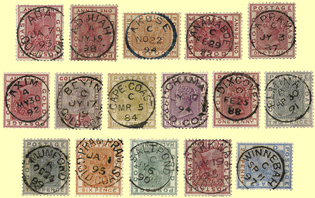 |
Fig.2 |
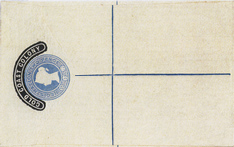 |
Fig.3 |
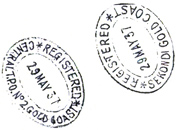 |
Fig.4 |
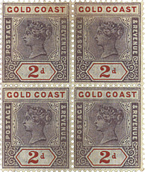 |
Fig.5 |
As postal routes into the interior were extended, many more towns and villages were supplied with their own date stamps providing interesting material for postmark collectors (fig.2). The humid climate, which later proved to be so suitable for the growing of cocoa, presented a problem for storing stamps in the post offices. This was perhaps one reason why prepaid postal stationery became popular from its introduction as early as 1880 (fig.3).
The turn of the century brought many developments. Early postmen were native runners who were given a sack and an instruction to convey the same along the route of a river or native path. However, paths were being turned into roads and railways were being driven through the forest jungle. Better communications meant more regular service and dependable schedules. Travelling Post Offices (fig. 4) on the trains meant pre-sorted mail arriving at the coast ready for forwarding.
In 1898, the key plate design was adopted for the definitive series (fig. 5) and higher values from 5/- to 20/- were added. Although Queen Victoria died in 1901 relatively soon after the new type had been introduced, a similar design was carried through the reigns of Edward VII and George V until 1928. One curiosity is the QV 2d stamp (SG27a) (Ref. 1) which did not reach the Gold Coast until 1902, after her demise, and yet was used for a short time until stamps of the new king had been distributed to all the offices.
Ref 1. Stanley Gibbons Part 1— British Commonwealth